
The Engines of Kenyan Chess: Celebrating Our Top Schools and Solving the “Teenage Exit”
The 2026 Kenya National Youth & Cadets Chess Championship (KNYCCC) in April was a spectacle of scale. With 8,635 players competing, the event proved that chess is no longer a peripheral hobby—it is a mainstream school sport.
But while the headlines focus on the massive total, the real story lies in the institutions. A handful of schools have moved beyond simply “offering chess” to becoming high-volume talent incubators
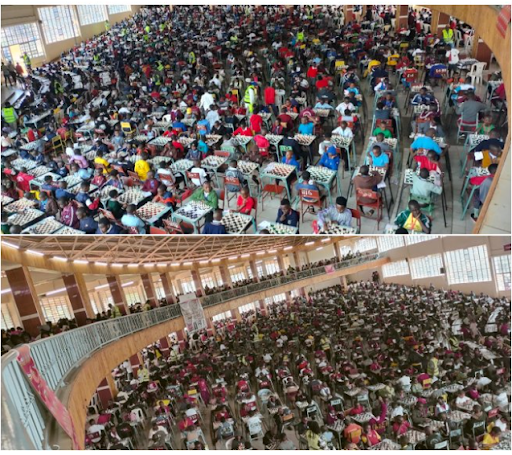
The Powerhouse Schools: The Top 10
The data shows that participation isn’t evenly distributed; it is driven by schools that have embraced chess as a core pillar of their identity. Lily Academy stands alone at the top, remarkably fielding nearly 200 players in a single national event.
Here are the top ten schools that are currently the backbone of the Kenyan chess ecosystem:
| Rank | School | No. of Participants |
|---|---|---|
|
1 |
Lily Academy |
174 |
|
2 |
Hilltop Preparatory School |
87 |
|
3 |
Kitale School |
76 |
|
4 |
The KBA Schools |
72 |
|
5 |
Goldfields School |
69 |
|
6 |
Bethlehem Academy |
61 |
|
7 |
Focus Academy |
56 |
|
8 |
Mang’u High School |
55 |
|
9 |
Camel Catholic Primary and Junior |
51 |
|
10 |
Josnah Primary and Junior School |
51 |
These schools are doing the heavy lifting. They aren’t just teaching a game; they are providing the “mass” that makes the Kenyan chess funnel so potentially powerful.
The Growing Shadow: Where Are the Older Kids?
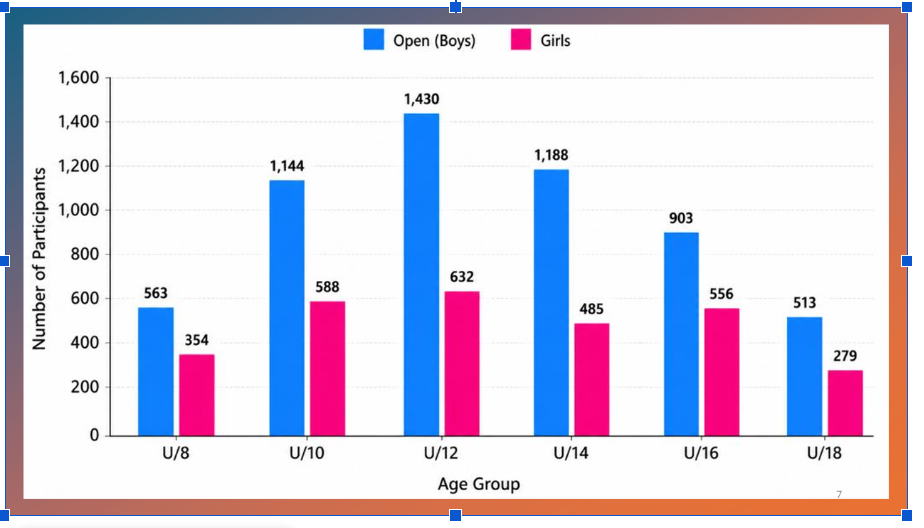
Despite the celebration, the data reveals a troubling trend. While the primary school categories are bursting at the seams—peaking at 2,062 players in the Under-12s category—the numbers fall off a cliff as children get older.
By the time we reach the Under-18 category, participation drops to just 792 players. That is a 60% loss of our competitive base in just six years.
We are witnessing a “Talent Leakage.” As academic pressure mounts and the focus shifts toward exams like the KCSE, chess is being discarded. Furthermore, 97.6% of all participants are unrated, meaning that for most of these 8,600 children, chess is a fleeting school activity rather than a tracked professional pursuit. If we do not provide a reason for a 16-year-old to keep playing, we are essentially building a foundation for a building that never gets finished.
Why should we strive to have more chess rated youth?
Having more children in their older teenage years (14–18) obtain official FIDE ratings is the bridge between a “youth activity” and a “sustainable professional ecosystem.” While mass participation (like the 8,000+ players in the KNYCCC) is a great foundation, a high volume of rated teenagers provides several critical benefits for the sport and the players themselves:
1. International Benchmarking and Mobility
A FIDE rating is a global “chess currency.” Without it, a player’s skill level is only known locally.
• Global Standing: It allows Kenyan teens to see exactly where they stand compared to peers in India, Europe, or the US.
• International Invitations: High-rated teenagers are more likely to receive invitations (and sometimes travel grants) to international open tournaments, which is essential for earning titles like International Master (IM) or Grandmaster (GM).
2. Unlocking University Scholarships
For older teenagers, chess must compete with intense academic pressure. A FIDE rating changes the value proposition:
• Global Scholarships: Many universities in the US (and increasingly in other regions) offer sports scholarships for chess. A high rating is often a prerequisite for these applications.
• Local Recognition: As the ecosystem matures, high-rated players can use their status to secure admissions or sports-based financial aid in local institutions, proving that chess is an academic asset rather than a distraction.
3. Strengthening the Coaching Pipeline
A rated 17-year-old is a massive asset to the grassroots system.
• Peer Mentorship: Rated teenagers can serve as high-quality coaches for the Under-8 and Under-10 categories.
• Economic Opportunity: For a teenager, being rated allows them to earn an income through private coaching or school programs, which encourages them to stay in the sport even as they transition to adulthood.
4. Attracting Corporate Sponsorship
Sponsors generally look for two things: Reach (high numbers) and Excellence (elite talent).
• High-Stakes Narrative: While thousands of beginners are great for brand visibility, a “National Top 10” of highly rated teenagers creates a competitive narrative that media and sponsors love to follow.
• ROI for Brands: Sponsors are more likely to fund a “Junior National Team” if those players have international ratings that prove they are capable of winning on the world stage.
5. Preventing “The Great Leakage”
The drop-off in participation between Under-12 and Under-18 is usually caused by a lack of a clear “next step.”
• Goal Setting: Obtaining and improving a rating provides a clear, data-driven goal. A teenager who is “chasing 1800” is far more likely to keep playing through their exam years than one who is simply playing casual school games.
• Ecosystem Stability: By keeping teenagers rated and active, you ensure that the “Open” (Adult) category remains strong, preventing the national chess scene from becoming top-heavy with only older veterans.
Summary: The Conversion Metric
If participation numbers (8,635) represent the quantity of the ecosystem, the number of rated older teenagers represents its quality. Converting unrated school players into rated teenage competitors is the single most important step in moving Kenya from a “chess-playing nation” to a “chess-dominating nation.”
Stemming the Leakage: How We Build the Ecosystem
To stop our best players from quitting and to turn these schools into true professional academies, we must implement three critical shifts:
1. Create “Chess Scholarships” and Academic Incentives
Parents of older children need to see chess as an asset, not a distraction. We must advocate for universities and high schools to offer sports scholarships for top-rated chess players. When a parent sees that a FIDE rating can help pay for college, the “leakage” will stop.
2. Institutionalize the “Lily Academy Model”
Schools like Lily Academy from Nairobi and Hilltop Preparatory School from Kitale shouldn’t just be participants; they should be recognized as “Centres of Excellence.”
The federation should partner with these top ten schools to embed permanent, high-level coaching academies on their campuses, ensuring that the 191 players at Lily Academy have a clear path to becoming FIDE-rated masters.
3. A Professional “Junior League”
Currently, most kids play one or two big events a year. To keep older kids engaged, we need a consistent, year-round Junior League with corporate backing. This creates a “career path” feel for the sport. If companies like Safaricom or KCB sponsor a high-stakes Under-18 circuit, the prestige alone will retain the talent we are currently losing.
4. Curriculum Integration
The ongoing petition to include chess in the school curriculum is vital. By making chess a recognized educational tool for critical thinking, we remove the “game” stigma and replace it with “academic development.”
The Bottom Line
We have the numbers. We have the powerhouse schools. We have the passion. But 8,600 unrated players is a “moment”—not yet a “system.”
If we don’t build the professional infrastructure to catch these players as they grow, we will continue to watch our best talents vanish at age 14. It is time to turn these school-based numbers into a national professional legacy.
Share this post :
Latest Posts


Mombasa Open Round 3
The Brain Loves Shortcuts

One Response
That was a very interesting read with great information for parents who are new to chess.Orpotunities would give incentive the older kids to keep playing.Theres a huge ecosystem that would benefit coaches,players, service providers etc